Even though in the past, scientists have considered nostalgia a destructive force, almost all recent papers reveal its healing power.
Unlike love, pain, sorrow, anger, or fear, nostalgia is the most personal feeling, for no one can see it but me. This sentimental longing resides solely in my head, deep in my mind. It is intimately my experience. No one can read nostalgia on my face. My body will not give it away. It is part of my identity.
Two things revive the major nostalgic moments for me: songs and smells. There are many, but those two do it for me. Songs and smells can unlock the most dormant memories I haven’t visited in a long time.
Wedding videos, party footage with friends, exotic travel videos I spent with my wife, or even scenes from my childhood do very little to awaken nostalgia, despite being the happiest moments of my life. But something as mundane as driving my 1995 Geo Prism and stopping at a light in a random neighborhood while Judas Priest’s Rapid Fire song came on unleashes a fury of emotions.
When these bouts of nostalgia appear, I would often start paying attention to the physical symptoms. I want to discover what the hell my body is doing. Is it releasing serotonin and dopamine or adrenaline?
It starts with tightening somewhere in between the stomach and my chest. It feels like a small rush of adrenalin soaking my abdomen at first. It then spreads to my throat and the bottom of my jaw.
If the nostalgia grows significantly strong, it will envelop my shoulders and climb into my skull, raising the hair on the back of my head.
It is not the feeling of falling in love. pain, anger, or sorrow either. The feeling is bitter-sweet but not painful. Possibly because ‘most’ of my nostalgic moments are happy or neutral. Once in a while, a bad one will slither in.
It is almost as if my brain is protecting me by preventing bad memories from seeping into those moments. This filtering of negative emotions was confirmed in research by neurologist Alan R. Hirsch.
Bittersweet is the best word I can come up with. The bitterness part seems to come from the notion that those moments are physically lost forever. A reminder that I was once young and now am not.
The sweet part is almost always comforting, a reminder of happy times that are forever mine. It’s a constant battle between two emotions.
I have noticed that nostalgia often comes involuntarily, by a trigger. But I can also conjure it up at will. I have a sort of bag of tricks I use every time I feel a bit down.
I keep a list of nostalgic triggers: songs, movies, and smells, and their corresponding years, locations, and events where and when nostalgia occurred. The list gets continuous updates as my brain recovers more details from the past. You’d be surprised how much detail you can dig up if you concentrate and comb through your mind. With time, the list grew into my life’s chronology. An emotional continuity if you will.
I could list all of the moments and they would mean absolutely nothing to you, but everything to me. Those moments are entirely mine. Hence why nostalgia is so personal.
I observed that if I keep listening to the nostalgia-invoking songs too many times, the nostalgic moment becomes less potent. So, if you want to destroy a certain memory invoked by a song, just play that song over and over.
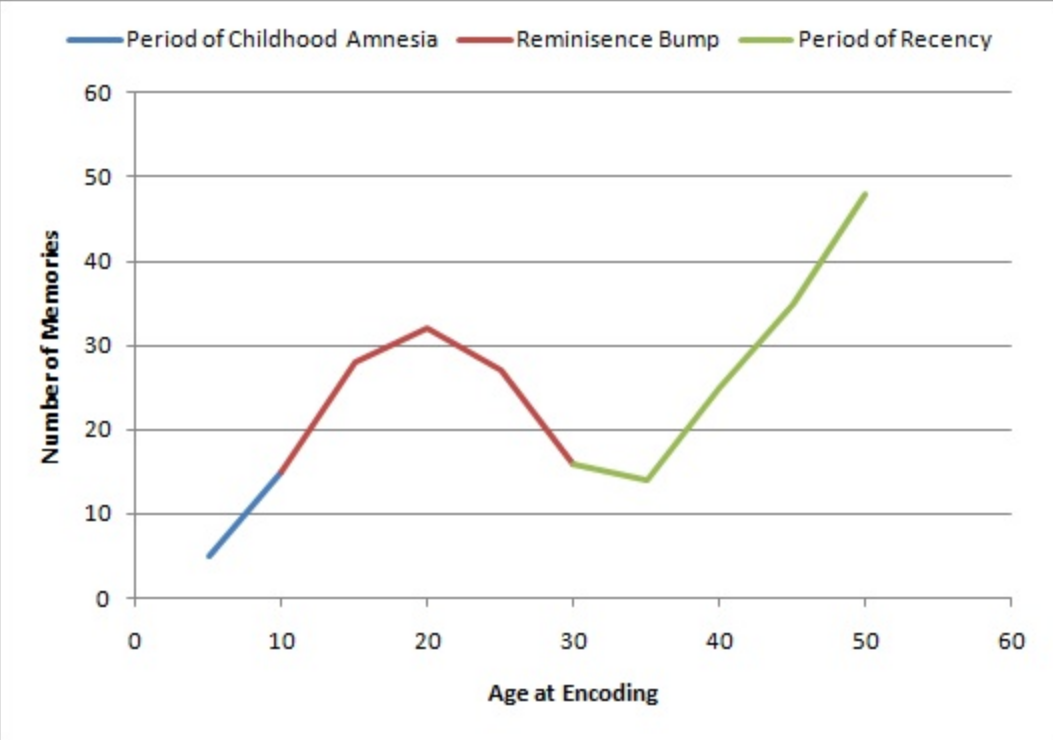
Here’s the surprising part. My most visceral nostalgic memories cluster around when I was 20 - 23 years old. Those were great times, but I can think of better ones. So why those?
Unbeknownst to me, scientists already had a theory. They call it the Reminiscence Bump and it is when autobiographical memories are at their highest. Exactly at 20.
I have to believe that nostalgia changes me for the better. It has to be a positive characteristic of natural selection, or it would have been weeded out a long time ago.
So, I do not look at nostalgia as mourning the past, but as treasuring it. Retaining it. And If I concentrate and let myself go I can almost relive it. Nostalgia reminds me of what it felt like to be young.
This is why new and exciting experiences are so important. New adventures are a timestamp in my mind, a continuous story I can always nostalgically look back on. Nostalgia makes me who I am.